Role
Lead Product Designer
Client
Stena Recycling
Timeline
Feb 2024 - Nov 2024
Empowering customers with a digital solution for Li-ion battery pickups
A self-service B2B flow to replace a fully manual pickup process, from research to pilot in Sweden.
The challenge
Booking a Li-ion battery pickup meant calling or emailing Stena directly. The process was slow and error-prone. Customers frequently misclassified batteries or sent incomplete information, creating safety risks and extra work for both sides.
What I did
I led the design from research to pilot, facilitating stakeholder workshops across multiple Stena markets, conducting user interviews, mapping the service flow, and designing the booking experience inside the existing customer portal. I worked closely with the PO to shape the roadmap.
The outcome
Piloted with 100 customers in Sweden. Manual handling time dropped from 30 to 60 minutes per order to around 15 minutes. The service has since launched to all customers in Sweden.
Impact overview
The goals
Business goal
Replace a slow, manual pickup coordination process and make every transport compliant without relying on customers knowing the rules upfront.
Customer goal
Book a Li-ion battery pickup independently, with clear guidance on how to assess, sort and package batteries before the truck arrives.
The problem space
Li-ion batteries span a wide range of types, conditions and volumes, from car workshops to industrial operators. The existing process put most of the burden on Stena: customers called or emailed, a coordinator gathered the information manually, and if something was wrong or missing, the back-and-forth started again.
The problem had a legal dimension too. All Li-ion battery transports are classified as dangerous goods under ADR regulations. Each battery condition, stable, defect, critical or burned, requires different packaging, documentation and handling. If a customer misclassified their batteries, Stena carried the compliance risk. Every wrong order created potential liability, not just extra admin.
The internal framing at the start of the project was clear: the existing process was making transport more expensive and more time consuming. The goal was to flip it, making compliance easier for the customer without increasing the burden on Stena's teams.
What success would look like: customers could assess their batteries, submit accurate information and book a pickup without contacting Stena first. The liability would shift to the customer in a way that felt clear and supported, not arbitrary.
What success would look like
Customers could assess their batteries, submit accurate information and book a pickup without contacting Stena first. The liability would shift to the customer in a way that felt clear and supported, not arbitrary.
Process highlights
Involving multiple markets early revealed how complex the problem really was
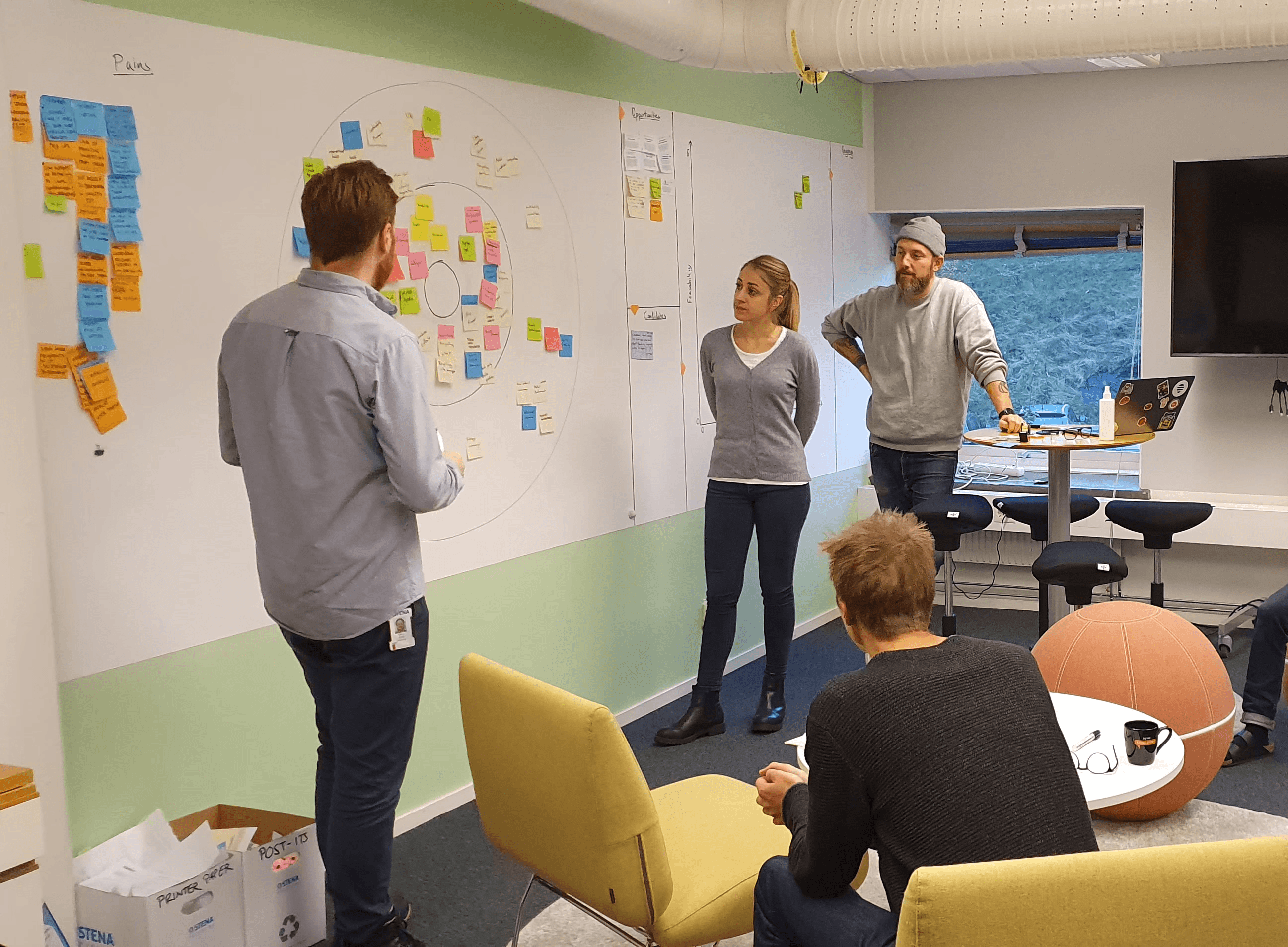
I facilitated stakeholder workshops with representatives from Sweden, Norway and Denmark. Each market had a fundamentally different customer base and process. Sweden was mostly existing portal customers, but 80 to 90% of orders still came in by email. Norway was largely new customers with no digital touchpoint, where a dedicated person at Stena would assess each battery by asking questions over the phone. Denmark had large car importers managing stable battery orders via Excel files that worked well for them and that they had no reason to abandon.
This meant the solution could not try to serve all contexts at once. Starting with Sweden gave us the clearest path: existing customers, an established portal, and a high volume of orders that were already creating internal overhead.
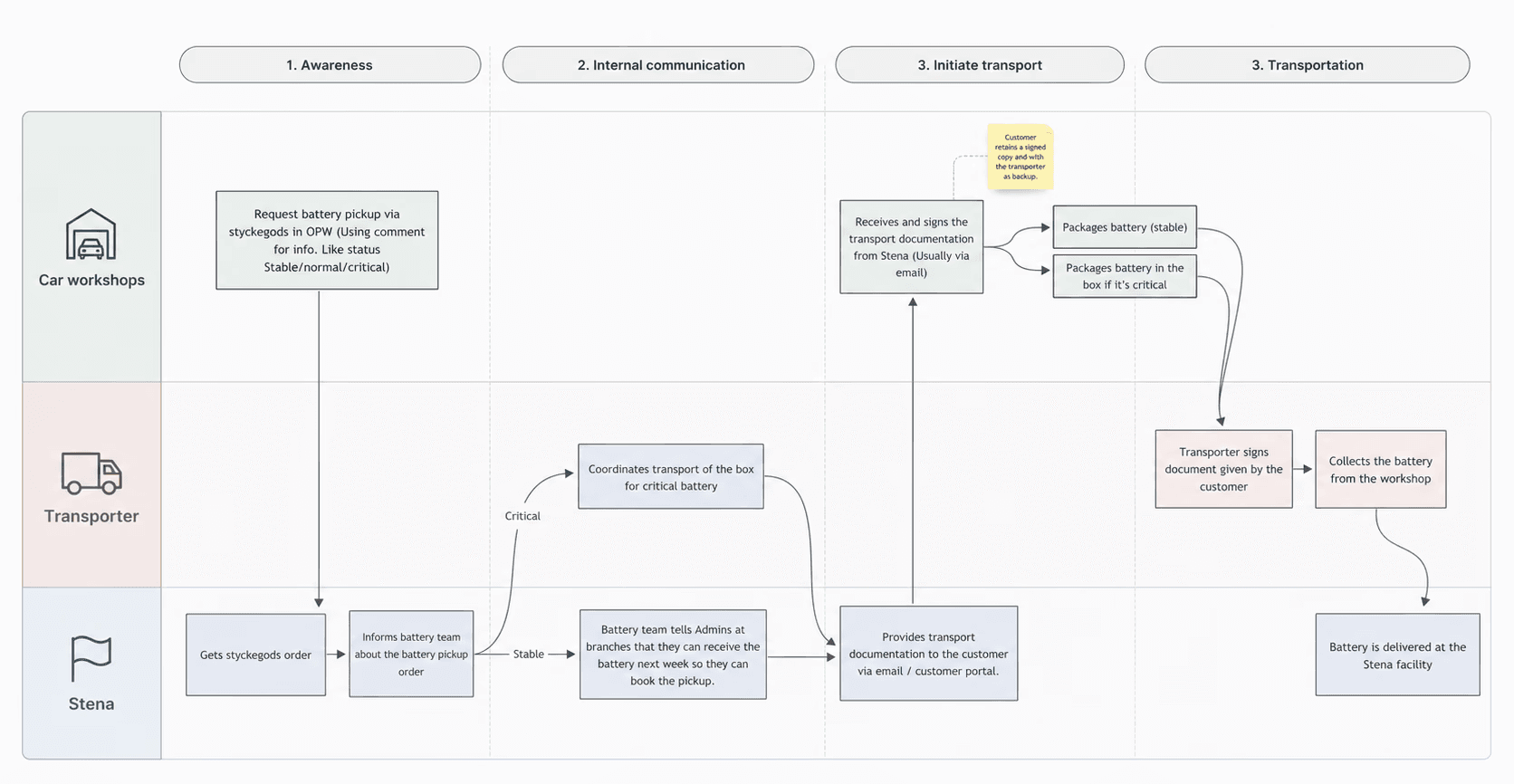
The current state map — how a battery pickup was handled before the digital service existed, across Car workshops, the Transporter and Stena's internal team.
Key decision - Run multi-market workshops before narrowing scope
Run multi-market workshops before narrowing scope. Getting perspectives from all three markets upfront gave us a much broader picture of the complexity, and meant the Swedish solution was designed with the other markets already in mind, not retrofitted later.
The interviews showed that customers didn't know what they didn't know
User interviews and testing sessions revealed a consistent pattern. Customers were not being careless. They simply lacked the knowledge to classify or package their batteries correctly. The digital flow had to teach as well as collect. Information, guidance and booking had to work together in sequence.
One thing that shaped the design significantly: Stena's battery team had already developed an internal assessment logic, a funnel of questions starting from the most critical condition downward. The more questions a customer could answer, the safer the transport outcome. This logic existed but was not accessible to customers. The design challenge was not to invent a classification system, it was to make an existing one usable by people with no specialist knowledge.
Assess the battery
Type, application, chemistry
Assess condition
Stable, damaged, critically damaged or unknown
Collect pickup details
Weight, quantity, dimensions, photos
Packaging
Standard, certified, safety box
Collection
Battery pickup and transport
Key decision - Design for one clear linear path, not multiple entry points.
Focusing on Sweden first let us design for a defined set of battery types and conditions, rather than trying to handle every edge case before validating anything. The rollout to other markets was always part of the plan, just sequenced deliberately.
Fitting the solution inside what already existed
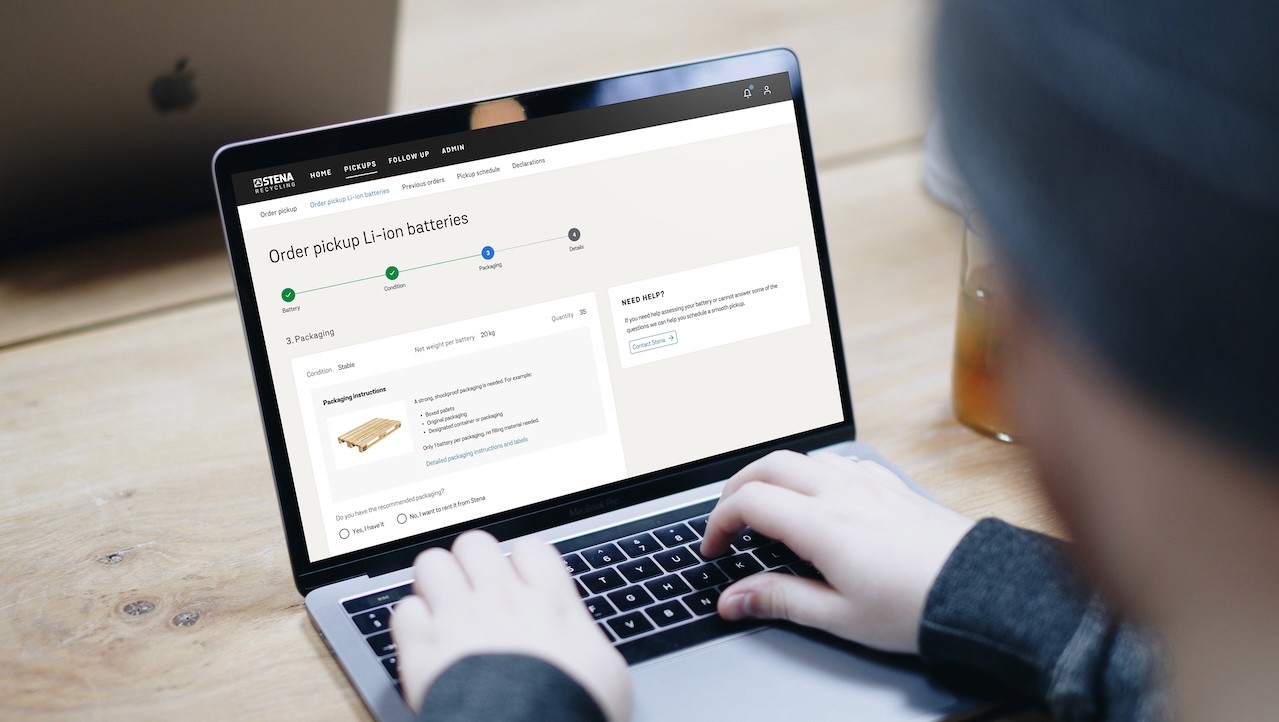
The booking service was designed within Stena's existing customer portal, not as a standalone product. Customers already had portal access, so no separate login, no new onboarding, and a faster path to rollout.
The design introduced a step-by-step flow guiding customers through battery type, condition, quantities and packaging requirements, with clear confirmation before submission.
Video showcasing the Li-ion Battery flow in the customer portal
Testing before launch: what we learned and what we changed
Testing before launch: what we learned and what we changed
What worked
Step-by-step guidance reduced uncertainty. Customers understood the overall flow. Visual support made battery classification easier to grasp.
Pain points
Some classification steps still felt too technical. A few users hesitated when required information was unclear. Users wanted more reassurance before submitting.
What we changed
Simplified labels and helper text. Added clearer contextual guidance. Improved step sequencing and confirmation moments.
Pilot launch
We launched in Sweden with 100 customers and used Hotjar surveys and follow-up interviews to gather feedback. Early survey responses averaged 4/5 across 12 customers, a positive signal, though too small a sample to treat as conclusive. Follow-up interviews confirmed that customers found the process clearer and more independent than calling directly. Minor usability points went into the backlog for the next phase.
Reflections
The stakeholder workshops were the most complex part of the project, not because the people were difficult, but because different Stena functions had genuinely different views of what the process should be. Getting to a single agreed current-state map took more time than any individual design decision. I would structure that alignment phase more deliberately from the start.
The user interviews were the most useful input to the design, but we ran them relatively late. Earlier contact with customers would have sharpened the problem framing before we started mapping flows.
On metrics: we agreed targets after the pilot rather than before it. The 15-minute handling time estimate came from the team's own assessment, not a formal measurement plan. Setting those criteria upfront would have made the evaluation sharper.
What I carried forward: in a service design project with multiple internal stakeholders, aligning on the current-state process is as much a design challenge as the product itself. Worth treating it that way from the start.
Comments from the team